India’s 1st Startup Consulting Company Earns YouTube Silver Button
India’s 1st Startup Consulting Company Earns YouTube Silver Button
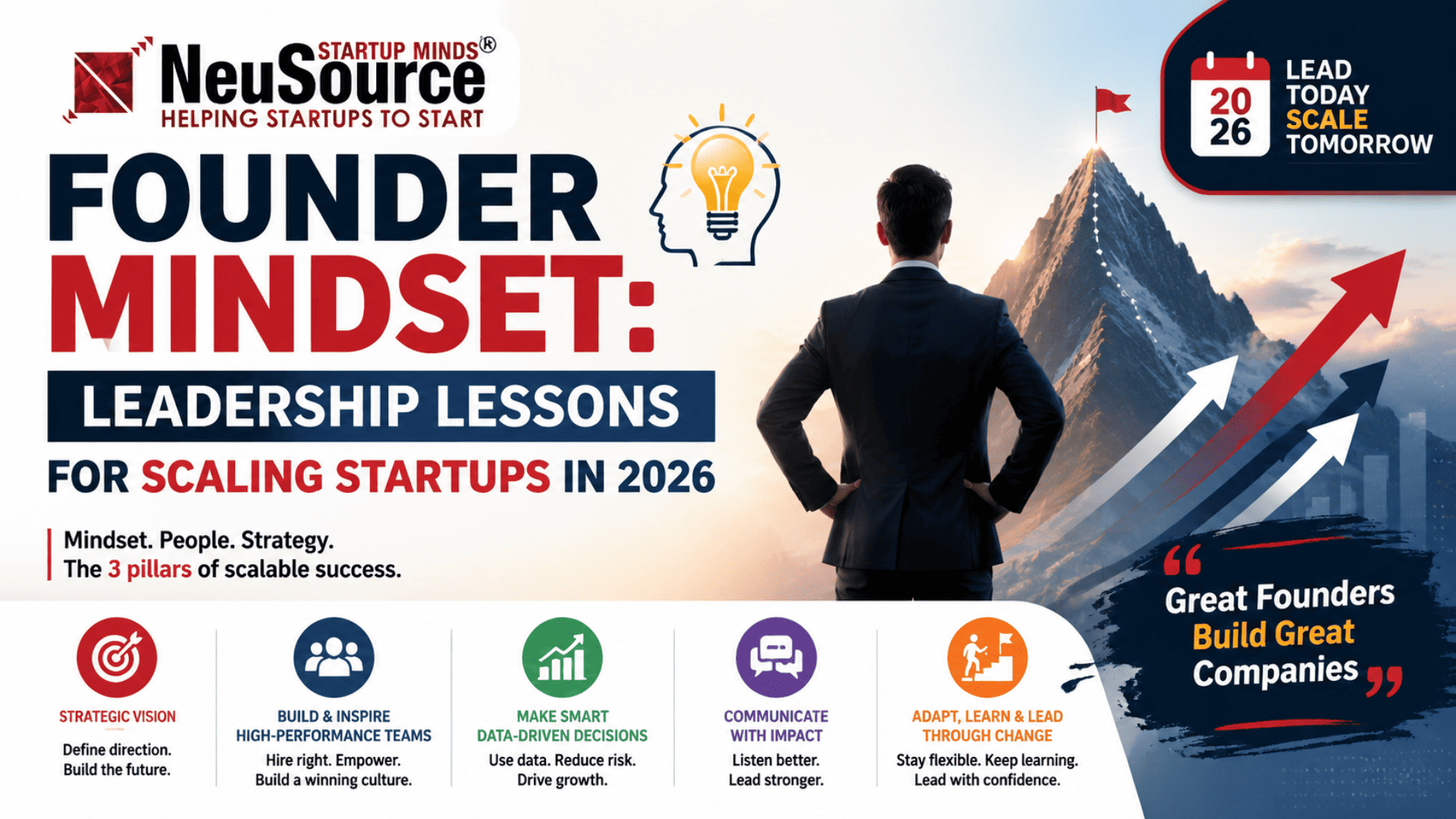
Every successful startup begins with an idea, but only a few transform into scalable businesses. While innovation, funding, and technology play important roles, one factor consistently separates startups that grow from those that struggle — the mindset of the founder.
In the early stages, founders manage everything themselves. They build products, interact with customers, manage finances, handle operations, and drive sales. However, as the startup grows, the founder's role must evolve from an individual contributor into a strategic leader.
Scaling a startup in 2026 requires more than a great product. It requires strong startup leadership, effective communication, strategic thinking, team-building abilities, and the capability to make decisions in uncertain environments.
With increasing competition, artificial intelligence, changing customer expectations, and evolving business models, founders must continuously improve their leadership skills to build sustainable companies.
This guide explains the essential founder skills, startup leadership lessons, and team-building strategies required to successfully scale startups in 2026.
A startup's biggest advantage is often not its product but the founder's ability to make effective decisions, adapt quickly, and lead people through challenges.
The founder's mindset directly influences:
Employees often follow the behaviour demonstrated by leadership. A founder who encourages accountability, learning, and ownership creates an organization that naturally follows these principles.
Many entrepreneurs confuse leadership with management. While both are important, they serve different purposes.
A scalable startup requires founders who can balance both management and leadership effectively.
During the early stage, founders focus on validating ideas and building products.
Responsibilities usually include:
As the company grows, founders must shift from doing everything themselves to building capable teams.
At this stage founders need to focus on:
A scaling startup cannot depend on one person's decisions. Founders must create systems and leaders who can independently drive growth.
The founder's focus shifts towards:
Successful founders understand that leadership is a continuous learning process.
A growth mindset allows founders to:
The best founders are not those who know everything, but those who continuously improve themselves.
A strong vision gives direction to the entire organization.
Founders should clearly communicate:
A clear vision attracts employees, investors, customers, and strategic partners who believe in the mission.
One of the biggest challenges for founders is letting go of complete control.
Delegation does not mean losing control. It means creating a stronger organization.
Effective delegation helps founders focus on:
Skills can be developed, but mindset and attitude define long-term success.
While building startup teams, founders should evaluate:
Company culture is created through everyday actions, not written statements.
Strong startup culture encourages:
A strong culture becomes a competitive advantage while scaling startups.
Communication is one of the most important startup leadership skills.
Founders should regularly communicate:
Effective communication builds trust and improves execution across teams.
Successful founders balance intuition with business data.
Important metrics include:
Data helps founders make smarter decisions and reduce unnecessary risks.
Leadership requires making difficult choices during uncertain situations.
Founders may need to make decisions related to:
Strong leaders prioritize long-term business success over short-term comfort.
Startup leadership is ultimately about managing people.
Emotional intelligence helps founders:
Many startups fail because founders spend too much time planning and too little time executing.
Successful startups follow a simple process:
Speed of learning often becomes the biggest competitive advantage.
Building the right team is one of the most important responsibilities of a founder.
Artificial intelligence is transforming startup operations and decision-making.
Founders are using AI for:
However, leadership qualities such as creativity, empathy, vision, and decision-making remain essential.
Building a successful startup requires more than an idea. Founders need access to mentorship, networking, industry insights, and a supportive startup ecosystem.
NeuSource World connects founders, mentors, investors, and startup professionals to help entrepreneurs strengthen their businesses.
Through initiatives like The Founders Meet, founders can interact with entrepreneurs and industry experts. The Founder Show provides startups with an opportunity to showcase their ideas, while Founder Bootcamp helps entrepreneurs strengthen business fundamentals. The Founders Talk shares practical lessons from experienced founders and industry leaders.
These ecosystem initiatives help founders improve leadership abilities, build confidence, and prepare their startups for sustainable growth.
Scaling a startup is ultimately a leadership challenge. Products, technology, and markets continue to change, but strong leadership creates the foundation for long-term success.
Founders who develop the right mindset, build strong teams, communicate effectively, and continuously learn are better prepared to create scalable and resilient companies.
In 2026, the founders who invest in leadership development alongside business growth will have a stronger advantage in building successful startups.
30 Jul
The internet offers opportunity, but only strategy builds success. Don't just exist online—dominate. Choose Neusource to craft your digital footprint and lead your business to its peak.